
Cash Envelopes vs. Digital Budgeting Apps: Finding What Fits Your Household
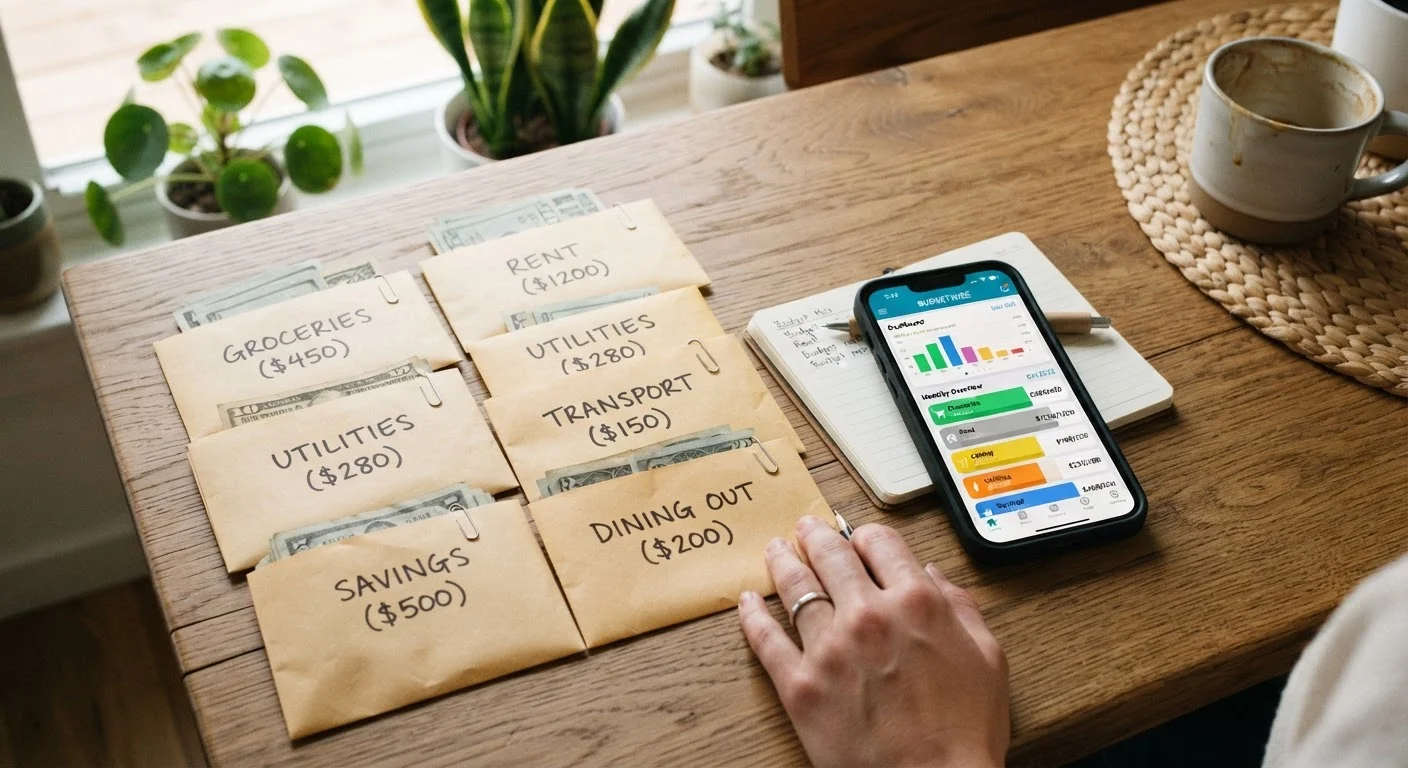
Photo credit: advancesimple.com
In this article
Two popular approaches to budget tracking, compared across ease of use, flexibility, and how well they support spending discipline.
Key Takeaways
- Cash envelopes create a hard spending limit by making money physical and finite.
- Digital budgeting apps sync with bank accounts and give a real-time view across all categories.
- Neither method costs much to start, but both require consistent upkeep to work.
- Households with mixed spending habits can combine both approaches without conflict.
- The method you will actually use consistently is the one worth choosing.
How each method works
The cash envelope system is straightforward. At the start of each pay period, you withdraw cash and divide it into labeled envelopes: one for groceries, one for gas, one for dining out, and so on. When an envelope is empty, spending in that category stops until the next fill. No app required, no bank login, no subscription.
Digital budgeting apps take a different path. Most connect directly to checking and savings accounts, pull in transactions automatically, and sort spending into categories. You set limits for each category, and the app tracks your progress throughout the month. Some apps are free with optional paid upgrades; others charge a monthly or annual fee.
Both methods follow the same core logic: assign every dollar a job before it gets spent. Where they differ is in how that assignment is enforced. Envelopes enforce it physically. Apps enforce it through visibility. For a broader look at building the structure around either method, see a household budget framework that holds month to month.
Spending discipline: which method holds the line
Cash envelopes have a mechanical advantage when it comes to stopping overspending. The money is gone when it is gone. There is no rounding, no credit buffer, no auto-transfer to cover the gap. For categories where overspending is habitual, such as groceries or restaurants, this hard stop can reset patterns quickly.
Digital apps rely on the user to check in, notice a warning, and change behavior. That is a larger ask. A notification that says you have $12 left in your dining budget does not prevent you from tapping a card. It informs; it does not block. That said, apps produce a complete picture of spending that envelopes cannot match. You can see in one screen whether your total household outflow is on track, which is valuable for families juggling multiple income streams or variable monthly bills.
If your household overspends because digital transactions feel unreal, envelopes will likely help more. Families overspend for predictable reasons, and the abstract nature of card payments is one of them.
| Cash envelopes | Digital budgeting apps | |
|---|---|---|
| Spending enforcement | Hard stop when envelope is empty | Notification-based, no hard block |
| Setup cost | Near zero | Free to ~$100/year |
| Works for online purchases | No, requires workarounds | Yes, syncs automatically |
| Shared household access | Physical envelopes only | Multi-user access on most apps |
| Privacy and security | Cash lost is unrecoverable | Bank-level encryption typical |
| Learning curve | Minimal | Low to moderate |
| Best for irregular income | Less flexible | More adaptable |
Practical friction and everyday use
Cash envelopes require a weekly or bi-weekly trip to the bank or ATM, accurate record-keeping for any online purchases that cannot use cash, and the mild awkwardness of counting bills at checkout. They also create a security concern: cash lost or stolen is gone. Families with heavy online spending will find the method clunky because so many transactions do not accept physical currency.
Apps remove that friction but introduce their own. Account sync errors happen. Transactions occasionally miscategorize. Free tiers sometimes limit features that matter, such as shared access for two spouses or reporting by custom date range. If a partner does not log in, the shared view breaks down. Consistent use by everyone in the household is a real requirement, not just a nice-to-have.
One practical middle ground: use envelopes for the two or three categories where you most commonly overspend, and use an app to track everything else. This keeps the discipline of physical cash where it does the most work while preserving the convenience of digital tracking for fixed bills and online spending. See a household spending audit to identify which categories deserve the tightest controls.
Cost and setup
Cash envelopes cost almost nothing. A set of envelopes from a dollar store, a pen, and a notepad are all the supplies needed. The real cost is time: withdrawing cash, dividing it, and tracking any non-cash spending manually each week.
Digital apps vary widely in price. Several capable options are available at no charge. Paid tiers typically run anywhere from a few dollars a month to around $100 per year, depending on the app and plan. Before paying for a premium tier, it is worth spending at least one month on a free version to confirm the app matches how your household actually tracks money. The Family Finance Tips hub has more context on tools and strategies that fit different household setups.
For families also weighing where to direct any freed-up cash, the question of emergency fund versus debt payoff is a natural next decision once a budget system is in place.
This article is for general informational purposes only and does not constitute personalized financial advice. Consult a qualified financial professional for guidance specific to your situation.

Author
Frugal Living Editorial Team
Frugal Living Editorial Team is the collective byline for our editorial team and contributor network. Articles published under this byline or an editorial pen name are researched, written, and reviewed according to our editorial standards for clarity, consistency, and independence before publication.
View all articles →