
Insulation Types for Existing Homes: What Actually Reduces Heating and Cooling Costs
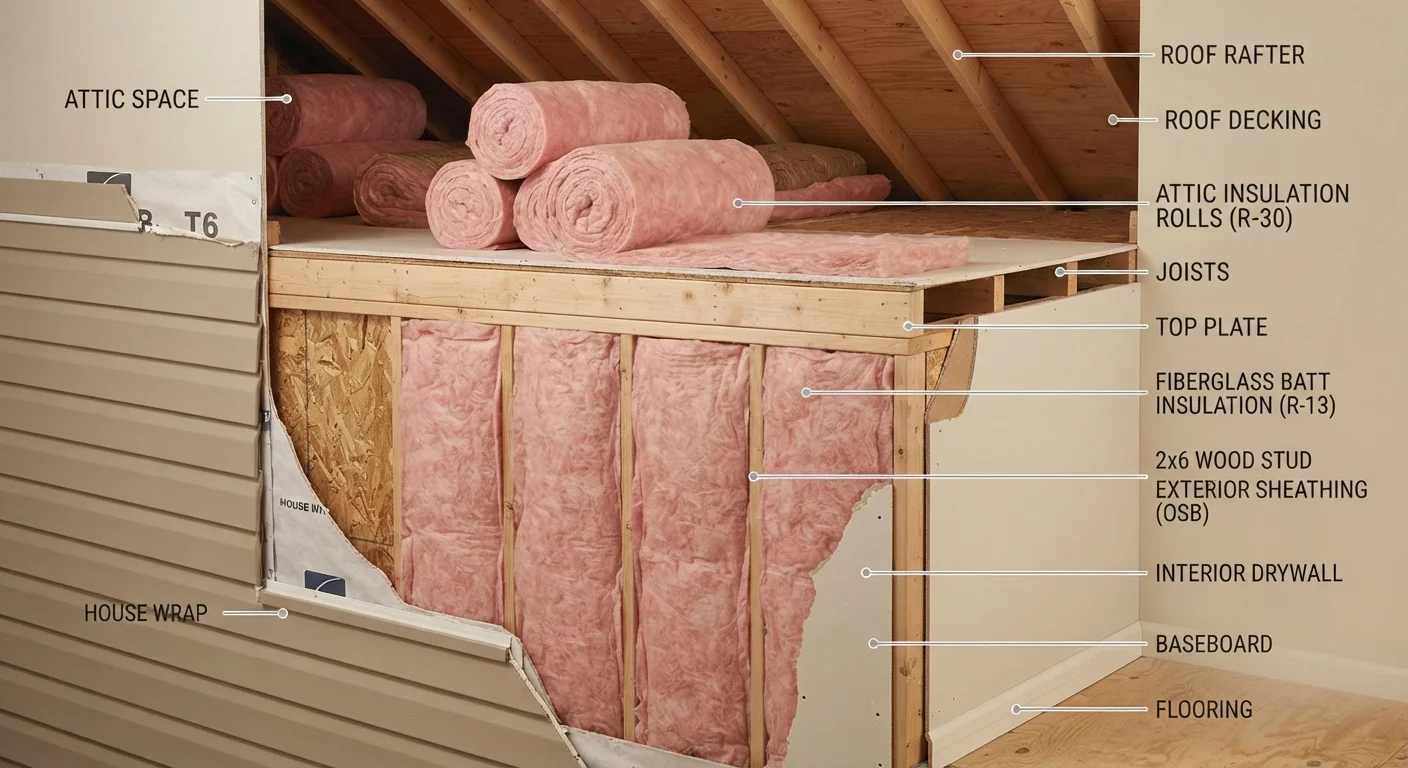
Photo credit: advancesimple.com
In this article
A factual reference covering the main insulation options available for existing homes, their R-values, applications, and cost considerations.
The basics: R-value and where heat actually escapes
Every insulation product carries an R-value rating, which measures its resistance to heat flow. A higher R-value means greater resistance. The number that matters for your home depends on your climate zone, the part of the house being insulated, and how much insulation is already there.
The U.S. Department of Energy divides the country into eight climate zones. Recommended attic R-values range from R-30 in warmer southern zones to R-60 in colder northern climates. Walls and floors have their own targets. Before spending money on insulation, it is worth checking your current levels: in most existing homes, the attic is where the largest heat gains and losses occur, followed by crawl spaces and basement rim joists.
Air sealing and insulation work together. Insulation slows heat transfer, but gaps and cracks let conditioned air escape directly. Sealing those gaps before or alongside insulation work improves results at low additional cost.
| Recommended attic R-value (cold climates, zone 5-8) | R-49 to R-60 (U.S. Department of Energy insulation recommendations) |
| Recommended attic R-value (warm climates, zone 1-3) | R-30 to R-38 (U.S. Department of Energy insulation recommendations) |
| Closed-cell spray foam R-value per inch | R-6 to R-7 (U.S. Department of Energy Building Technologies Office) |
| Cellulose (blown-in) R-value per inch | R-3.2 to R-3.8 (U.S. Department of Energy Building Technologies Office) |
| Typical location with largest heat loss in existing homes | Attic floor (U.S. Department of Energy Home Insulation guidance) |
| Federal tax credit availability for insulation materials | Periodically available; verify current rules (IRS Energy Efficient Home Improvement Credit (check IRS.gov for current status)) |
Main insulation types for existing homes
Retrofit projects have different constraints than new construction. Walls are already closed, attic access varies, and budgets are limited. The five types below are the ones most commonly applied in existing homes.
Fiberglass batts
Pre-cut blankets of spun glass fiber that fit between standard stud and joist spacing. R-value runs roughly R-2.9 to R-3.8 per inch. Batts are a common choice for exposed attic floors and open crawl spaces because they are inexpensive and can be installed by a capable homeowner. They do not fill irregular cavities well, and any compression reduces their rated R-value.
Blown-in fiberglass and cellulose
Loose-fill material blown into attic floors or, with a special nozzle, into closed wall cavities through small holes. Cellulose is made from recycled paper treated with borate for fire resistance and typically reaches R-3.2 to R-3.8 per inch. Blown-in fiberglass lands around R-2.2 to R-2.7 per inch. Both materials conform to irregular spaces better than batts, making them the standard choice for topping up attic insulation in existing homes. Cellulose tends to settle slightly over time, which is factored into installation depth targets.
Spray polyurethane foam (SPF)
Two-component foam that expands on contact and cures in place. Open-cell foam reaches about R-3.7 per inch; closed-cell foam reaches R-6 to R-7 per inch and also acts as a vapor retarder. Closed-cell foam is common in crawl spaces, basement walls, and roof deck applications ("hot roof" assemblies). Because SPF involves chemical mixing and off-gassing during installation, it requires professional application and proper ventilation. This is not a DIY material.
Rigid foam board
Panels of expanded polystyrene (EPS), extruded polystyrene (XPS), or polyisocyanurate (polyiso) cut to fit flat surfaces. R-values range from about R-3.8 per inch for EPS to R-6.5 per inch for polyiso. Rigid board is useful on basement walls, crawl space walls, and exterior sheathing during a siding replacement project. It does not work well in enclosed wall cavities without a renovation that opens the walls.
Mineral wool (rock wool or slag wool)
Made from volcanic rock or steel-mill slag spun into fibers. R-value is roughly R-3.0 to R-3.3 per inch. Mineral wool batts are naturally fire-resistant, do not absorb moisture readily, and hold their shape without compression. They cost more than fiberglass batts but are often preferred where moisture or fire resistance is a priority, such as in basement stud walls.
R-value
A measure of an insulation material's resistance to heat flow. Higher numbers mean more resistance. Required R-values vary by climate zone and location in the home.
Blown-in insulation
Loose-fill insulation material (typically fiberglass or cellulose) installed by blowing it through a hose with a machine. Used to top up existing attic floors or fill closed wall cavities.
Vapor retarder
A material that slows the movement of moisture through a building assembly. Required placement and perm rating depend on climate zone; incorrect installation can trap moisture and cause damage.
Closed-cell spray foam
A type of spray polyurethane foam with a dense, closed cell structure that gives it high R-value per inch and low moisture permeability. Generally requires professional installation.
Thermal bridging
Heat transfer that bypasses insulation by moving through a more conductive material, such as a wood stud or metal framing. Continuous rigid foam on exterior walls can reduce this effect.
Climate zone
A geographic classification system used by the U.S. Department of Energy to set insulation minimums and energy code requirements. Zones range from 1 (hottest) to 8 (coldest).
Cost and decision considerations
Installation cost varies by material, access, and labor market. Blown-in cellulose added to an existing attic floor is generally one of the more cost-effective retrofit moves because attic access is straightforward, labor is fast, and the material is inexpensive. Spray foam jobs cost more per square foot but may address air sealing and insulation in a single pass in tight spaces like crawl spaces.
Payback depends on how underinsulated a home currently is. A home with no attic insulation sees a much faster return than one going from R-30 to R-49. The U.S. Department of Energy's Home Energy Saver tool and local utility energy-audit programs can estimate potential savings specific to your house and climate zone without requiring you to guess.
Some insulation work requires permits, particularly any project that alters a vapor barrier, fire-blocking, or structural element. Check with your local building department before starting. Electricians and HVAC professionals may need to be involved if insulation work would cover recessed lights, junction boxes, or mechanical equipment.
Federal residential energy tax credits have periodically covered a portion of insulation material costs for existing homes. Check the IRS website and your state's energy office for current rules, since these programs change. As a general principle, do not let a potential credit drive a project you would not otherwise undertake: credits reduce cost, they do not eliminate it.
For a broader look at which home improvement shortcuts tend to backfire, see common renovation myths that cost more over time. Pairing insulation upgrades with low-cost household habits compounds the savings without requiring additional investment.

Author
Home on a Budget Editorial Team
Home on a Budget Editorial Team is the collective byline for our editorial team and contributor network. Articles published under this byline or an editorial pen name are researched, written, and reviewed according to our editorial standards for clarity, consistency, and independence before publication.
View all articles →