
Frozen vs. Fresh Produce: Which Delivers More Nutritional Value for Your Dollar
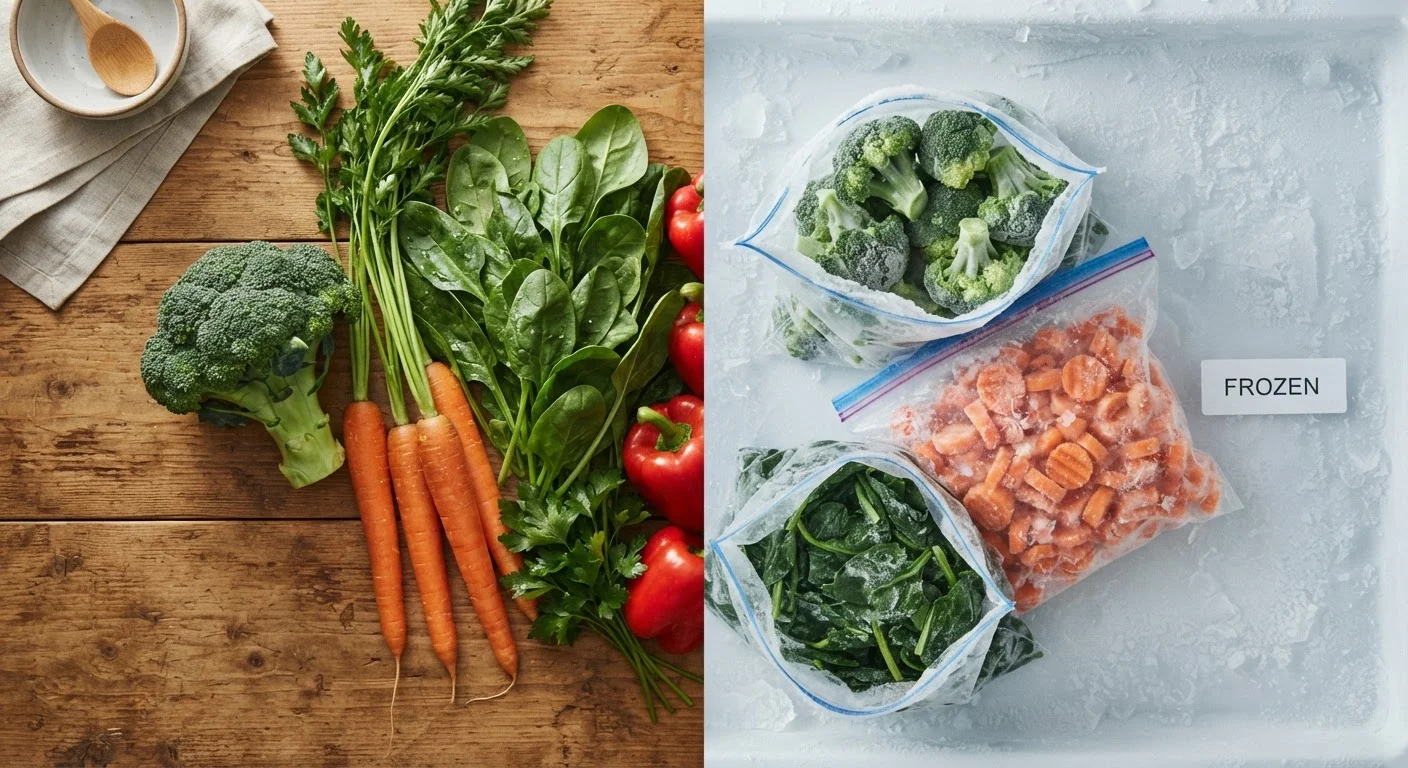
Photo credit: advancesimple.com
In this article
A side-by-side look at frozen and fresh vegetables to help you understand nutrient retention, cost, and convenience trade-offs.
Key Takeaways
- Frozen vegetables are typically harvested and flash-frozen within hours, locking in nutrients before degradation begins.
- Fresh produce can lose measurable amounts of certain vitamins during transit, storage, and display time at retail.
- Frozen produce generally costs less per serving than fresh equivalents, with far less food waste.
- Both forms can support a nutritious diet; the better choice depends on what you actually use before it spoils.
- Certain nutrients like vitamin C degrade faster than others, making the fresh-versus-frozen gap uneven across vegetables.
What happens to nutrients before produce reaches your plate
Fresh vegetables begin losing certain nutrients the moment they are harvested. Vitamin C, which is water-soluble and sensitive to heat, light, and air, can degrade noticeably over days of transit and retail storage. A study published in the Journal of Agricultural and Food Chemistry found that some fresh vegetables stored under typical supermarket conditions for several days had lower vitamin C levels than their frozen counterparts.
Frozen produce follows a different path. Most commercially frozen vegetables are blanched briefly in hot water to deactivate enzymes that cause spoilage, then flash-frozen within hours of harvest. Blanching does reduce some heat-sensitive vitamins, particularly B vitamins and vitamin C, but the process stops further degradation almost entirely. What remains at the time of freezing stays largely stable for months.
The practical implication: a bag of frozen spinach purchased in January in a landlocked state may contain more vitamin C than fresh spinach that spent five days in transit and two more days in a refrigerator drawer. This is not always the case, but the assumption that fresh automatically means more nutritious does not hold across the board.
For more on what research actually shows about eating nutritiously without overspending, see what nutrition science says about budget-friendly eating.
Cost and waste: where the real difference shows up
| Criterion | Fresh produce | Frozen produce |
|---|---|---|
| Nutrient retention at time of eating | Varies with transit and storage time | Stable after flash-freezing |
| Cost per serving | Seasonal variation; higher off-season | Consistent year-round, often lower |
| Shelf life at home | Days to one week, depending on type | Months in a standard freezer |
| Food waste risk | Higher, especially for leafy greens | Low; portion as needed |
| Texture for raw use | Suitable for raw preparations | Poor; freezing softens cell structure |
| Variety available | Broader, including specialty items | Wide but skewed toward common vegetables |
| Best cooking method fit | Raw, roasted, grilled, sauteed | Steamed, stir-fried, soups, stews |
Fresh produce pricing swings with the season. Strawberries in June cost a fraction of what they do in January. Out-of-season fresh vegetables frequently cost more per pound and may arrive in poorer condition after longer shipping routes. Frozen prices, by contrast, are relatively stable year-round because the product is processed at seasonal volume and stored commercially.
Food waste compounds the cost gap. The USDA has estimated that American households waste a significant share of the produce they buy, with fresh vegetables spoiling before they are used. Every wilted bag of salad greens or soft zucchini that goes into the trash is money spent on nutrition never consumed. Frozen produce eliminates most of this loss because you portion what you need and seal the rest.
Smarter produce choices are one part of a broader approach to grocery budgeting that does not require sacrificing nutritional quality.
30-50%
Estimated household fresh produce waste
USDA and Natural Resources Defense Council research has estimated that American households discard a substantial share of fresh produce before it is consumed.
Within hours
Time from harvest to freezing for commercial frozen vegetables
The Institute of Food Technologists has noted that most commercial frozen vegetables are processed and frozen within hours of harvest to preserve nutrient content.
15-55%
Vitamin C reduction in some fresh vegetables after 3-4 days of refrigeration
Research published in the Journal of Agricultural and Food Chemistry observed measurable vitamin C loss in certain vegetables stored under typical retail and home refrigeration conditions.
When fresh produce has the advantage
Fresh produce is not at a disadvantage across the board. Vegetables and fruits bought in peak local season, particularly at farmers markets or from nearby farms, have often traveled fewer miles and sat in less storage than supermarket fresh. In those cases, the nutrient profile can match or exceed commercially frozen options.
Texture is also a genuine difference. Freezing ruptures cell walls as water expands into ice crystals. Thawed broccoli or zucchini works well in a stir-fry or soup but becomes soft when served raw. For salads, grain bowls, or dishes where crunch and visual appeal matter, fresh is functionally required.
Some produce items also freeze poorly, including lettuce, cucumbers, tomatoes intended for fresh eating, and fresh herbs. For those, fresh is the only practical option. The point is not to replace all fresh produce with frozen, but to recognize where each performs well and where the cost or nutrient tradeoff shifts.
See why the perception of healthy eating as expensive often breaks down for a broader look at food cost myths.
Building a practical mix for your household
Most households benefit from using both forms rather than treating this as a binary choice. A reasonable approach is to keep a rotating stock of frozen vegetables for cooked dishes, soups, and quick weeknight meals, while buying fresh produce strategically when it is in season, locally available, or on sale.
Frozen options that consistently hold up well include peas, corn, edamame, broccoli, green beans, cauliflower, and leafy greens like spinach used for cooking. Fresh options that make sense for most households year-round include carrots, cabbage, onions, and root vegetables, all of which have long shelf lives and low spoilage risk.
Stocking a predictable base of nutrient-dense foods alongside frozen vegetables reduces the frequency of shopping trips and keeps costs more predictable. For a structured look at how grocery spending habits affect overall nutrition, principles for grocery spending on a tight budget provide a practical framework.
This article is for general informational purposes only and does not constitute medical or nutritional advice. Consult a registered dietitian or qualified healthcare professional for guidance specific to your health needs.

Author
Affordable Healthy Living Editorial Team
Affordable Healthy Living Editorial Team is the collective byline for our editorial team and contributor network. Articles published under this byline or an editorial pen name are researched, written, and reviewed according to our editorial standards for clarity, consistency, and independence before publication.
View all articles →